How Much Does a Real Estate ISA Cost in 2026?
A complete breakdown of real estate ISA costs in 2026: salary ($40-60k), benefits, training, commission splits, and hidden expenses. Compare traditional ISAs to AI alternatives.

Hiring an ISA seems straightforward until you add up the real numbers. Most agents underestimate the true cost by 40-60%.
TL;DR: A full-time real estate ISA costs $65,000-$120,000 annually when you factor in salary, benefits, training, tools, and turnover. AI alternatives deliver comparable results at 5-10% of that cost with zero ramp-up time and 24/7 availability.
Key Takeaways
- Base salary alone is $40,000-$60,000 for a competent ISA in 2026, before any additional costs
- Hidden costs add 40-60% on top of salary when you include benefits, training, tools, and management time
- Average ISA turnover is 18-24 months, meaning you'll repeat hiring and training costs frequently
- AI-powered solutions cost $500-$2,000/month and work around the clock without sick days or turnover
The Base Salary Reality
Let's start with what you'll pay an ISA directly. In 2026, the market looks like this:
Entry-Level ISA (0-1 Years Experience)
- Base salary: $35,000-$45,000
- Commission: 5-10% of team commission on closed deals
- Total compensation: $45,000-$65,000
Experienced ISA (2+ Years)
- Base salary: $45,000-$60,000
- Commission: 10-15% of team commission
- Total compensation: $65,000-$90,000
Top-Tier ISA (Proven Track Record)
- Base salary: $55,000-$75,000
- Commission: 15-25% of team commission
- Total compensation: $85,000-$150,000+
These numbers vary by market. ISAs in San Francisco, New York, or Miami command 20-30% higher salaries than those in smaller metros.
The Hidden Costs Most Agents Miss
Here's where the real expenses hide.
Benefits Package (Add 20-30%)
A competitive benefits package includes:
| Benefit | Annual Cost |
|---|---|
| Health insurance | $6,000-$12,000 |
| Dental/Vision | $1,200-$2,400 |
| 401(k) match | $1,500-$3,000 |
| Paid time off | $3,000-$5,000 |
| Total | $11,700-$22,400 |
Without benefits, you'll struggle to attract quality candidates. The ISAs willing to work without benefits are usually the ones you don't want.
Training and Ramp-Up (3-6 Months)
New ISAs don't produce on day one. Expect:
- Training period: 2-4 weeks of intensive onboarding
- Ramp-up time: 3-6 months to reach full productivity
- Your time investment: 5-10 hours/week managing them initially
During ramp-up, you're paying full salary for 30-50% productivity. That's $15,000-$25,000 in "lost" productivity costs.
Tools and Technology
Your ISA needs:
| Tool | Monthly Cost |
|---|---|
| CRM seat | $50-$200 |
| Dialer system | $100-$300 |
| Lead lists | $200-$500 |
| Phone/Computer | $50-$100 |
| Monthly Total | $400-$1,100 |
| Annual Total | $4,800-$13,200 |
Management Overhead
Someone has to manage your ISA. That's either you (opportunity cost) or a team leader (direct cost). Budget 5-10 hours per week of management time, worth $2,500-$5,000 monthly in opportunity cost.
The Turnover Problem
Here's the number that kills most ISA ROI calculations: average ISA tenure is 18-24 months.
When your ISA leaves, you lose:
- Hiring costs: $2,000-$5,000 in recruiting, interviewing, background checks
- Training investment: Everything you taught them walks out the door
- Productivity gap: 4-8 weeks to hire, 3-6 months to ramp up a replacement
- Lead leakage: Leads falling through cracks during transition
Many teams cycle through 2-3 ISAs before finding one that sticks. Each turnover costs $15,000-$30,000 in direct and indirect expenses.
Total Cost of Ownership: The Real Numbers
Let's calculate the true annual cost of a mid-level ISA:
| Category | Annual Cost |
|---|---|
| Base salary | $50,000 |
| Commission (estimated) | $15,000 |
| Benefits | $15,000 |
| Tools/Technology | $8,000 |
| Management time | $12,000 |
| Training (amortized) | $5,000 |
| Turnover cost (amortized) | $10,000 |
| True Annual Cost | $115,000 |
That's the real number. Not the $50,000 salary you budgeted.
AI Alternatives: The 2026 Comparison
AI-powered ISA solutions have matured significantly. Here's how they compare:
AI ISA Advantages
- Cost: $500-$2,000/month ($6,000-$24,000/year)
- Availability: 24/7/365, no sick days or vacations
- Response time: Under 60 seconds, every time
- Scalability: Handle unlimited concurrent conversations
- Consistency: Same quality at 9 AM and 9 PM
Where Human ISAs Still Win
- Complex objection handling requiring empathy
- Building deep personal rapport over months
- Navigating unique or unusual situations
- Reading between the lines on motivation
The Hybrid Approach
Top-performing teams in 2026 use both:
- AI handles initial response and qualification (24/7)
- Human ISA takes warm, qualified leads during business hours
- Result: Lower human ISA workload, higher conversion rates
This approach typically costs 40-50% less than full human coverage while improving response times.
ISA Costs in 2026: The Real Numbers
The cost landscape for inside sales agents has shifted significantly since this article was first published in January. Human ISA costs have continued to climb, AI ISA pricing has stabilized at remarkably accessible levels, and the hybrid model has emerged as the dominant approach for cost-conscious teams. Here are the fully loaded numbers for mid-2026.
Human ISA: $5,000-$7,000/month fully loaded
The fully loaded cost of a human ISA — meaning salary, benefits, tools, management, training, and amortized turnover — now runs $60,000-$84,000 annually, or $5,000-$7,000 per month.
Here's the breakdown:
| Cost Component | Monthly Cost | Notes |
|---|---|---|
| Base salary | $3,300-$5,000 | $40K-$60K annual, varies by market |
| Benefits (25%) | $825-$1,250 | Health, dental, 401(k), PTO |
| Tools & tech | $400-$800 | CRM, dialer, lead lists, phone |
| Management overhead | $500-$1,000 | Team lead time, coaching, QA |
| Training (amortized) | $250-$500 | Onboarding + ongoing skill development |
| Turnover (amortized) | $625-$1,000 | Based on 18-month average tenure |
| Total | $5,900-$9,550 | Midpoint: ~$7,000/month |
The key insight here is that salary is only 50-60% of the true cost. The hidden layers — benefits, tools, management, turnover — add 60-80% on top of base pay.
AI ISA: $500-$2,000/month all-in
A managed AI Sales Agents platform now costs $500-$2,000 per month with no hidden layers:
| Tier | Monthly Cost | What You Get |
|---|---|---|
| Starter | $500-$800 | Basic qualification, scheduling, CRM integration |
| Professional | $800-$1,500 | Custom scripting, multi-channel, advanced routing |
| Enterprise | $1,500-$2,000+ | Full customization, dedicated support, SLAs |
At AI Voice Agent Pricing these levels, the cost per qualified interaction is typically $2-$8, compared to $25-$60 for a human ISA.
Hybrid model: $3,000-$5,000/month
The hybrid approach — AI handling initial contact and qualification, human ISA closing and relationship-building — costs $3,000-$5,000 monthly:
| Component | Monthly Cost | Notes |
|---|---|---|
| AI platform | $800-$1,500 | Handles 70-80% of initial contact volume |
| Human ISA (part-time or reduced caseload) | $2,000-$3,500 | Focuses on warm leads and follow-up |
| Tools & management | $200-$500 | Shared infrastructure |
| Total | $3,000-$5,500 | Midpoint: ~$4,000/month |
The hybrid model delivers 80-90% of the output of a full human ISA team at 40-60% of the cost. It's the model that AI Lead Response platforms are increasingly optimized for.
ISA vs AI ISA: 2026 Head-to-Head
Beyond cost, the comparison between human and AI ISAs comes down to activity metrics, conversion performance, and return on investment. Here's the data from brokerage deployments in 2026.
Activity metrics
| Metric | Human ISA | AI ISA | Advantage |
|---|---|---|---|
| Calls per day | 60-100 | 500-2,000+ | AI |
| Texts per day | 40-80 | 1,000-5,000+ | AI |
| Hours available | 8/day | 24/day | AI |
| Response time | 5-30 minutes | Under 60 seconds | AI |
| Days off per year | 20-30 | 0 | AI |
| Consistency | Variable | Identical every time | AI |
A single AI Receptionist or AI ISA handles the outbound volume of 8-15 human ISAs. This isn't theoretical — it's the observed output from AI Voice Agent deployments across mid-size and enterprise brokerages.
Conversion rates
| Stage | Human ISA | AI ISA | Notes |
|---|---|---|---|
| Contact rate | 15-25% | 20-35% | AI's instant response timing improves contact |
| Qualification rate | 30-40% | 25-35% | Human edge on nuanced qualification |
| Appointment set rate | 10-15% | 12-20% | AI's speed and consistency compensate |
| Show rate | 50-60% | 55-65% | AI's immediate scheduling + follow-up helps |
| Close rate (from set) | 15-25% | 15-25% | Equal — human takes over at this stage |
The critical takeaway: AI ISAs excel at the top of the funnel (speed, volume, consistency), while human ISAs maintain an edge in middle-funnel nuance. This is exactly why the hybrid model works — let AI maximize the top of the funnel and let humans focus on where they add the most value.
Cost per meeting comparison
| Model | Monthly Cost | Meetings Set | Cost per Meeting |
|---|---|---|---|
| Human ISA (1 FTE) | $7,000 | 40-60 | $117-$175 |
| AI ISA (managed) | $1,200 | 80-150 | $8-$15 |
| Hybrid (AI + part-time human) | $4,000 | 100-180 | $22-$40 |
The AI ISA delivers meetings at roughly 1/10th the cost of a human. The hybrid model offers the best balance of cost, quality, and volume.
ROI comparison
For a brokerage generating 200 leads per month:
Human ISA team (2 FTEs):
- Monthly cost: $14,000
- Monthly meetings: 80-120
- Cost per meeting: $117-$175
- Assuming 20% close rate and $8,000 average commission: $128,000-$192,000 monthly revenue
- ROI: 9x-14x
AI ISA platform:
- Monthly cost: $1,500
- Monthly meetings: 100-180
- Cost per meeting: $8-$15
- Assuming 20% close rate and $8,000 average commission: $160,000-$288,000 monthly revenue
- ROI: 107x-192x
Hybrid model (1 part-time human + AI):
- Monthly cost: $4,000
- Monthly meetings: 120-200
- Cost per meeting: $20-$33
- Assuming 20% close rate and $8,000 average commission: $192,000-$320,000 monthly revenue
- ROI: 48x-80x
The ROI advantage of AI and hybrid models is substantial, but the real story is in the absolute numbers. At $4,000/month, a hybrid ISA operation generates the same revenue as a $14,000/month human team — freeing $10,000/month for marketing, technology, or agent support.
When human ISAs still win
The numbers favor AI and hybrid models on cost and volume, but human ISAs maintain advantages in specific scenarios:
-
High-value, relationship-driven sales. When average commissions exceed $20,000 and the sales cycle runs months, the human ISA's ability to build genuine rapport and navigate complex objections can't be fully replicated by AI.
-
Markets requiring deep local knowledge. A human ISA who knows a specific neighborhood, its schools, its vibe, and its recent sales history can provide context that AI can't match from data alone.
-
Complex multi-party transactions. When a lead involves divorce situations, estate sales, or investor groups with multiple decision-makers, human judgment and emotional intelligence become essential.
The 2026 verdict
For most brokerages, the answer isn't "human or AI" — it's "how do I deploy AI to maximize what my humans do best?" The AI Lead Response landscape has matured to the point where AI handles the volume game better, faster, and cheaper than any human team. The winning strategy is to let AI own the top of the funnel — instant response, consistent qualification, 24/7 coverage — and route the warmest, most qualified leads to your best humans for the close.
If you're still running a purely human ISA operation in 2026, you're paying 5-10x more than you need to for a fraction of the output. The math has changed. It's time to update your model.
FAQ
Is it worth hiring an ISA in 2026?
It depends on your volume. If you're generating 50+ leads per month and can afford the true $80,000-$120,000 annual cost, a human ISA can be worth it. For lower volumes, AI solutions often deliver better ROI.
Can I pay an ISA commission-only?
You'll get what you pay for. Commission-only ISAs typically underperform, churn quickly, and may not prioritize your leads over other income sources. A reasonable base plus commission produces the best results.
How long before an ISA becomes profitable?
Expect 4-6 months before a new ISA reaches break-even productivity. Full ROI typically takes 12-18 months, assuming they stay that long.
What's the biggest mistake when hiring an ISA?
Underestimating total costs and expecting immediate results. Budget for the full cost (not just salary) and plan for a 6-month ramp-up period.
Related Reading
- Speed-to-Lead: Why 5 Minutes Is Already Too Late — Why response time matters more than who responds
- Best AI Tools for Real Estate Agents in 2026 — Complete guide to AI solutions
- AI vs Human ISA: The Real Comparison — Side-by-side cost and capability analysis
- Human ISA Alternative — Why AI Sales Agents are replacing traditional ISAs
- Build vs Buy for AI Sales Agents — CFO's guide to the build vs buy decision
- AI Voice Agent vs Human Receptionist — Updated comparison including the hybrid model
- Fair Housing AI Compliance in 2026 — Compliance requirements for AI in real estate
Want to see how AI Sales Agents can handle your lead response at a fraction of ISA costs? Book a demo to see Prestyj in action.
Related reading
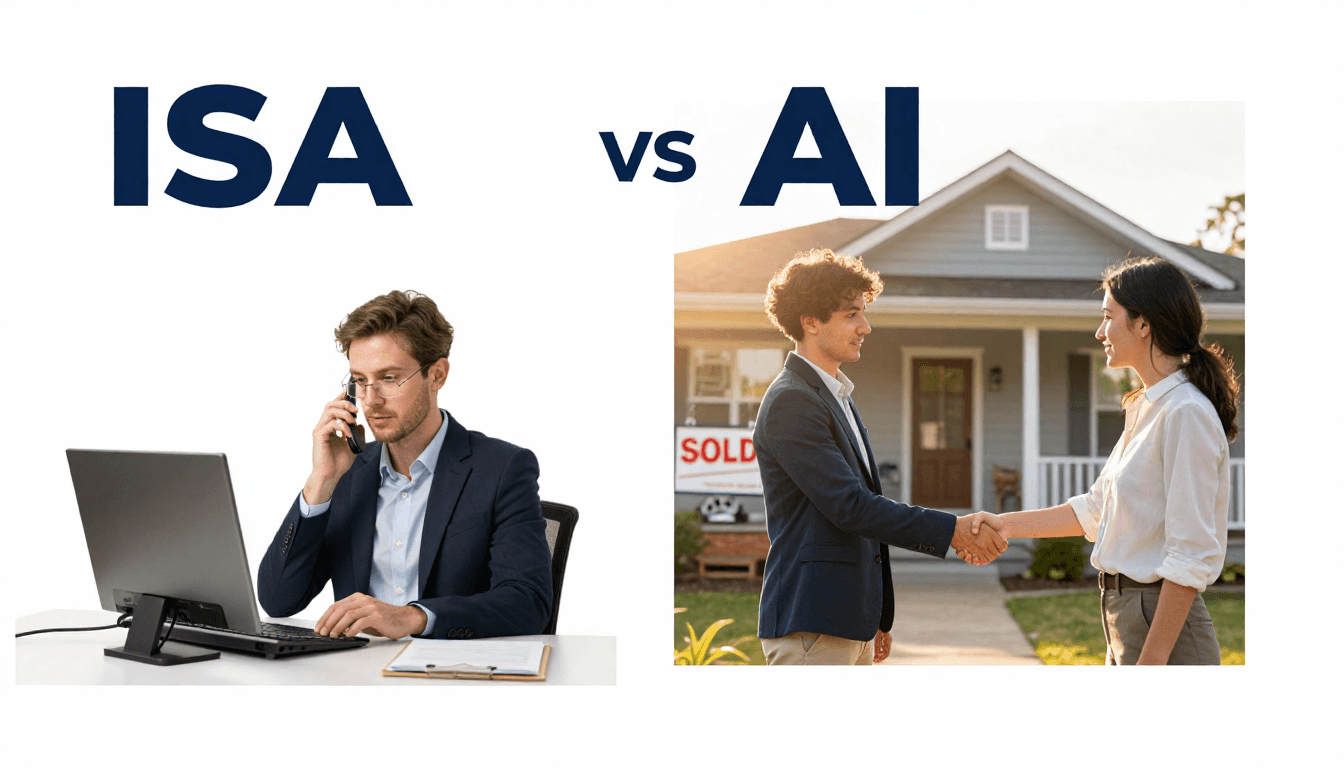
Inside Sales Agents cost $4,000+/month plus commission. Compare ISA vs AI sales agents: costs, availability, conversion rates, and ROI for real estate lead qualification.

A practical AI operating model for real estate investment funds: reconcile asset data, surface material discrepancies, route exceptions, and automate controlled work.
A 4-role home-services AI sales workflow for fast response, qualification, booking, and consent-based reactivation—with costs and human handoff.