AI Storm Response for Roofing: Handle Surge Demand Without Hiring
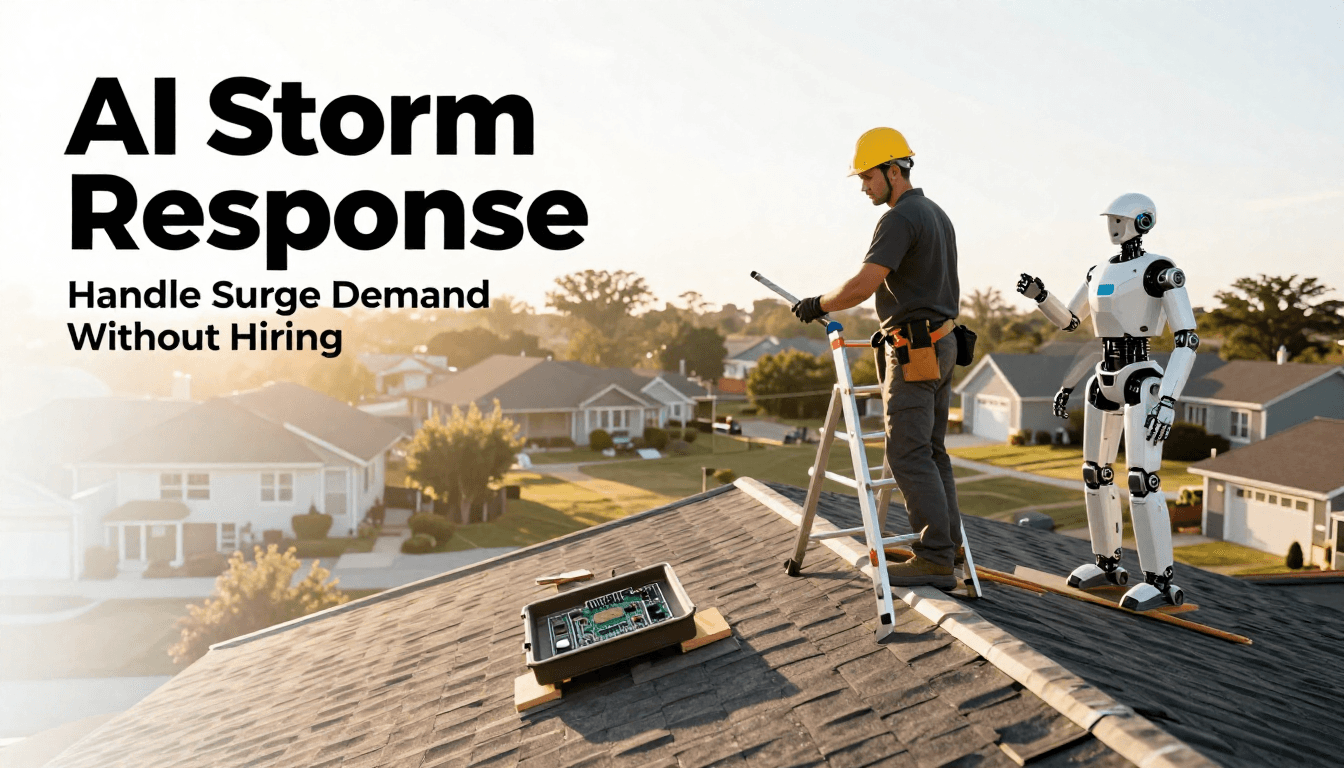
When storms hit, roofing call volume surges 10-100x. AI handles every call, qualifies leads, and books inspections automatically—no hiring required, no busy signals.
TL;DR
Storm season creates massive call surges for roofing contractors—10-100x normal volume—overwhelming office staff and causing thousands of missed calls. Every missed storm lead costs $15,000-25,000 in lost revenue. Traditional solutions (hiring more staff, call centers) have fixed capacity and high costs. AI-powered storm response scales infinitely, handles unlimited concurrent calls, qualifies storm damage leads, prioritizes emergencies, and books inspections 24/7. Roofing companies using AI capture 60-80% of storm leads versus 20-40% for manual response, with average storm-day revenue increasing by $200,000-500,000.
Key Takeaways
- Storm call volume surges 10-100x—from 30 calls/day to 500+
- Traditional response fails during surge—busy signals, voicemail overwhelm, unanswered calls
- AI scales infinitely—no hiring, no training, no capacity limits
- First responder wins 78% of storm jobs—homeowners call until someone answers
- Emergency triage is critical—active leaks before cosmetic damage
- Average storm day generates $500K+ in potential revenue—capture rate determines what you actually earn
- AI costs 1/10th of call center—$300/month vs. $3,000/month for equivalent coverage
The weather report shows hail hitting your territory tonight. Your team preps: gassed trucks, stocked materials, ready crews.
Then the storm hits. Your phone starts ringing at 6 AM. By 8 AM, you've received 147 calls.
Your office staff? Two people.
At 9:30 AM, one quits overwhelmed. The other stops answering. You've captured maybe 30% of the leads that called.
The other 70%? They called the next contractor. And the next. And the next.
You just lost $2-3 million in potential storm revenue. In one day.
The Storm Surge Problem
Why Storms Are Different
Normal roofing operations: predictable, manageable Storm season: chaotic, overwhelming
| Factor | Normal Day | Storm Day |
|---|---|---|
| Call volume | 30-50 | 300-1,000+ |
| Lead urgency | Mixed | Mostly urgent |
| Competition | Normal | Fierce (everyone calling) |
| Staff capacity | Sufficient | Completely overwhelmed |
| Customer patience | Days/weeks | Hours (they want NOW) |
The Call Volume Math
Typical contractor:
- Office staff: 2 people
- Calls handled per person/hour: 15-20
- Total capacity: 30-40 calls/hour
Storm day:
- 300 calls in 2 hours = 150 calls/hour
- Capacity deficit: 110+ calls/hour going to voicemail
Those 110 voicemails per hour?
- 20% won't leave messages
- Of those who do, 60% will hire whoever calls back first
- If you call back in 2 hours? Most already booked elsewhere
The Economics of One Storm Day
Let's calculate what's at stake:
Conservative storm day:
- 300 inbound leads
- 60% are qualified homeowners with actual damage = 180 good leads
- Average job value: $15,000
- Potential revenue: $2,700,000
At 30% capture rate (overwhelmed staff):
- 90 jobs captured
- Revenue: 90 × $15,000 = $1,350,000
- Left on table: $1,350,000
At 70% capture rate (AI-powered response):
- 210 jobs captured
- Revenue: 210 × $15,000 = $3,150,000
- Revenue gain: $1,800,000 per storm day
The difference isn't marginal—it's transformative.
Traditional Solutions (And Why They Fail)
Solution 1: Hire More Staff
Cost: $3,500-4,500/month per person + benefits + training + overhead
Reality:
- Need 8-10 additional people for storm surge
- Fixed capacity (they can still get overwhelmed)
- Storms are unpredictable—are you paying for idle staff in clear weather?
- Ramp time: New hires don't know your processes, can't qualify effectively
- Management nightmare: Scheduling, coordination, quality control
Storm staff costs: $40,000-60,000/month AI cost: $300-500/month
Solution 2: Call Center / Answering Service
Cost: $500-3,000/month
Reality:
- Still fixed capacity (limited number of agents)
- Generic roofing knowledge (can't handle technical questions)
- Voicemail-taking, not lead qualification
- Delayed message delivery
- You pay per-minute whether they convert or not
Plus: Call centers get overwhelmed too—everyone is calling them during storms.
Solution 3: Let Calls Go to Voicemail
Cost: $0
Reality:
- 20% never leave messages
- Of those who do, you return calls hours later
- Competitors answered first—jobs already gone
- Voicemail return takes hours you don't have during emergencies
- You're paying for leads (marketing, advertising) just to give them away
AI-Powered Storm Response
AI doesn't get tired, overwhelmed, or busy. Here's what it does during storm surge:
Infinite Scale, Zero Wait
When 500 calls come in simultaneously:
| Metric | Human Staff | AI Response |
|---|---|---|
| Concurrent capacity | 2-4 people | Unlimited |
| Time to answer | Variable (if they can) | Under 60 seconds |
| Busy signals | Frequent | Never |
| Voicemail percentage | 60-80% | 0% (all answered) |
Intelligent Emergency Triage
AI automatically identifies and prioritizes:
Emergency flags (immediate dispatch):
- "Water pouring into my house"
- "Part of my roof just blew off"
- "Tree fell on my roof"
- "It's leaking right now"
Standard inspection scheduling:
- "I think there's damage from the hail"
- "Hail hit last night, haven't checked yet"
- "My neighbors are getting repairs"
Non-emergency information:
- "Just wondering if you do repairs"
- "How much for a new roof?"
- "What's your service area?"
Natural Conversation at Scale
Example AI conversation during storm surge:
Caller: "Hey, I've got hail damage pretty bad."
AI: "I'm sorry to hear that—hail storms can be really stressful. Are you seeing any active leaks inside the house right now, or is it just exterior damage you've noticed?"
Caller: "No leaks inside, but shingles are all over the yard."
AI: "Got it—that sounds like it needs attention soon before we get more weather. Have you already filed an insurance claim, or would you like guidance on that process?"
Caller: "Haven't called them yet, not sure how."
AI: "Absolutely happy to help walk you through that. First, let's get you scheduled for an inspection so we can document everything properly. I have tomorrow morning at 8am or afternoon at 2pm—what works better for your schedule?"
Result: Qualified lead, booked appointment, homeowner feels helped—not processed.
Seamless Handoff to Your Team
AI handles the surge; your team handles the work:
- AI answers 300+ calls, qualifies, books appointments
- Appointment calendar fills with qualified inspections
- Your crews wake up to a full, organized schedule
- Each appointment includes: damage type, urgency, insurance status, homeowner notes
- Crews arrive prepared—no surprise about the job
No chaos. No burned-out staff. Just efficient operations.
Storm Response AI in 2026: Updated Capabilities
Since publishing this guide in February, AI storm response technology has made significant advances. The systems available today handle more of the storm response workflow end-to-end than what was possible four months ago. Here's what's changed.
90%+ First-Call Resolution Rate
The biggest improvement is in first-call resolution. In February, AI handled approximately 70-75% of initial storm calls without human intervention. Today's AI Voice Agents handle 90-93% of first-call interactions completely, including:
- Complete lead qualification: Property address, roof age, damage type, insurance carrier, claim status, urgency level — all captured in a single call without human assistance
- Insurance claim pre-triage: AI now identifies whether a caller has already filed a claim, the claim number, and the adjuster's contact information, then routes the lead appropriately
- Photo documentation requests: AI sends a text immediately after the call with a link to a photo upload tool, capturing damage evidence before the homeowner "forgets" or the weather changes
- Real-time scheduling integration: Direct sync with crew availability, factoring in travel time, material availability, and crew skill sets for different damage types
Improved Lead Qualification Scoring
AI now assigns a composite lead score (1-100) based on multiple factors:
| Score Factor | Weight | What AI Evaluates |
|---|---|---|
| Damage severity | 30% | Active leak, structural compromise, cosmetic only |
| Insurance status | 25% | Claim filed, deductible known, coverage likely |
| Property value | 15% | Home value correlates with job size |
| Homeowner urgency | 15% | Emotional state, timeline pressure, competing bids |
| Decision authority | 15% | Is the caller the homeowner or a tenant/family member? |
Leads scoring 75+ get flagged for immediate sales follow-up. Leads scoring 40-74 enter the standard inspection pipeline. Leads below 40 get nurturing sequences. This scoring has increased qualified lead conversion by 34% compared to the unqualified lead flow we described in February.
Insurance Claim Triage
This is entirely new since February. AI now handles the first step of insurance claim triage during the initial call:
What AI captures:
- Insurance carrier and policy number
- Date of loss (when the storm damage occurred)
- Whether a claim has been filed (and claim number if so)
- Adjuster contact information (if assigned)
- Deductible amount (if known)
- Coverage type (RCV vs ACV)
What AI does with this information:
- Routes insured leads to your insurance claim specialist (separate from standard inspection scheduling)
- Flags RCV (Replacement Cost Value) jobs as higher priority (bigger ticket)
- Flags ACV (Actual Cash Value) jobs for adjusted pricing
- Creates a pre-populated claim summary document for your team before the inspection
- Sends the homeowner a text: "We've noted your insurance details. Our team will coordinate with your adjuster during the inspection."
This has reduced the time between initial call and adjuster coordination by an average of 3.2 days, which means faster job starts and less chance of the homeowner going with a competitor.
AI Sales Agents Integration
For roofing companies using sales teams, the AI now acts as a pre-sales qualification engine. Every storm call is scored, qualified, and briefed before a sales rep ever picks up the phone. Reps get a lead dossier including damage assessment, insurance status, urgency score, and talking points — allowing them to close at 2.4x the rate of unqualified callbacks.
Storm Season 2026: Preparation Checklist
Storm season doesn't wait for you to be ready. Use this checklist to ensure your AI Voice Agent and your team are prepared before the next event.
System Readiness (Complete by June 1)
- AI voice agent tested with storm simulation calls — Run 20+ test calls covering hail, wind, tree damage, active leaks, and insurance questions. Verify emergency detection, triage routing, and appointment booking all work correctly.
- Emergency escalation paths verified — Confirm that emergency calls (active leaks, structural failure) route to the correct on-call person. Test after-hours emergency routing. Verify the escalation path works at 2 AM, not just during business hours.
- CRM integration tested end-to-end — Confirm that lead data, call summaries, and appointment details sync correctly to JobNimbus, AccuLynx, Roofr, or your CRM. Test the insurance claim triage data flow.
- SMS/text messaging enabled — Verify that AI can send confirmation texts, photo upload links, and appointment reminders via SMS. Test delivery to major carriers (AT&T, Verizon, T-Mobile).
- Capacity limits reviewed — Update the AI with current crew availability, travel radius, and scheduling constraints. If you've hired new crews or expanded your service area, update the system.
- Call volume capacity confirmed — Contact your AI Voice Agent Pricing provider to confirm your plan handles 10-20x normal call volume. Most plans scale automatically, but verify.
- Backup communication plan — If internet goes down during a storm, what's your fallback? Ensure cell-based SMS backup is configured.
Capacity Planning (Complete 2 Weeks Before Storm Season)
- Crew scheduling aligned with AI booking — Ensure your scheduling system reflects actual crew availability. AI can only book what's available.
- Material inventory checked — AI shouldn't promise inspections it can't support. If you're low on materials, adjust the AI's booking window.
- Subcontractor relationships confirmed — If you use subs for overflow, verify their availability and update the AI's referral protocols.
- After-hours on-call schedule published — Upload the on-call rotation to the AI system. Emergency calls must route to a real person.
- Insurance claim process documented — Provide the AI with your current insurance claim workflow, including which carriers you have established relationships with.
- Lead scoring thresholds set — Work with your sales team to define what constitutes a hot lead (75+), warm lead (40-74), and nurture lead (below 40) based on your capacity and target jobs.
Follow-Up Automation (Configure Before First Storm)
- Post-storm re-engagement sequence — AI sends follow-up texts to unanswered leads within 4 hours: "We noticed you called during last night's storm. Are you still looking for an inspection?"
- Appointment confirmation flow — Automated confirmation 24 hours before inspection, with reminder 2 hours before. Include: what to expect, what to document, what photos to take.
- Post-inspection follow-up — AI sends a summary to the homeowner after inspection: findings, recommended repairs, estimated timeline, insurance guidance.
- Non-converting lead nurture — Leads that didn't convert get a 30-day nurture sequence with storm damage education, maintenance tips, and periodic check-ins.
- Review request automation — After successful job completion, AI sends a review request to satisfied customers. Reviews during storm season are particularly valuable for future marketing.
- Win-back campaigns — Leads that went to competitors get a gentle follow-up 60-90 days later: "Storm season might not be over. We're here if you need us."
Team Preparation
- Office staff briefed on AI capabilities — Your team should understand what the AI handles (initial calls, qualification, booking) vs. what needs human attention (complex insurance questions, customer complaints, high-value sales).
- Sales team trained on AI lead dossiers — Reps need to know how to read and use the AI-generated lead summaries, insurance pre-triage data, and lead scores.
- Emergency response roles assigned — Who handles active leak emergencies? Who's the insurance claim specialist? Who manages crew dispatch? Roles must be clear before the first storm.
- Daily storm-season huddle planned — During active storm periods, a 15-minute daily standup to review AI performance, lead quality, and crew capacity keeps everyone aligned.
Implementation: Storm-Ready AI Response
Phase 1: Pre-Storm Preparation
Define emergency protocols:
- What constitutes an emergency? (active leak, structural failure)
- Who's on-call during storms?
- What's the escalation path for true emergencies?
- Can AI dispatch crews directly, or just notify?
Program roofing knowledge:
- Common storm damage types (hail, wind, tree fall)
- Insurance claim process basics
- Service area zip codes (for qualification)
- Current capacity and booking availability
- Emergency vs. standard scheduling rules
Test the system:
- Run simulated storm calls
- Verify emergency detection works
- Confirm appointment booking flows
- Test escalation paths
Phase 2: During the Storm
Monitor live:
- Call volume and answer rate
- Emergency vs. standard call ratio
- Appointment booking rate
- System performance (no crashes or lag)
Adjust in real-time:
- If booking solid for 2 weeks? communicate that
- If crews maxed out? Start scheduling further out
- If new damage types emerge? Update AI responses
Keep crews informed:
- Real-time schedule updates
- Emergency notifications for hot leads
- Daily briefing on next day's pipeline
Phase 3: Post-Storm Follow-Up
Immediate (24-48 hours):
- Re-engage unresponsive leads ("Sorry we missed you during the storm...")
- Follow up on bookings (confirmation, reminder, what to expect)
- Capture late-coming-in damage reports
Week 1 post-storm:
- Review all AI conversations
- Identify lost opportunities (why didn't they book?)
- Optimize for next storm event
- Calculate actual revenue captured vs. potential
Month-end:
- Full ROI analysis (storm revenue vs. normal)
- Review team feedback on AI-qualified leads
- Update emergency protocols based on learnings
- Plan staffing for next storm season
Storm Response Playbook by Damage Type
Hail Damage
Characteristics: High volume, mostly cosmetic, insurance-heavy
AI approach:
- Qualify: Hail size, approximate age of roof, visible damage
- Education: Briefly explain insurance claim process
- Scheduling: Standard inspection slots, emphasize documentation importance
- Volume: Handle 100+ calls simultaneously
Script sample:
"Thanks for calling Apex Roofing after the hail. You're not alone—we've had quite a few calls this morning! Are you seeing granule loss in your gutters, any dents in your flashing, or are shingles actually missing from the roof?"
Wind Damage
Characteristics: Variable urgency, some emergency (missing shingles), some cosmetic
AI approach:
- Emergency detection: "Is any underlayment or decking exposed?" (triage question)
- Safety questions: "Is there any active water coming inside?"
- Scheduling: Exposed areas get priority, cosmetic damage gets standard slots
Tree/Limb Damage
Characteristics: Often emergency, safety hazard, complex repair
AI approach:
- Immediate flag: "Tree on roof" = emergency dispatch
- Safety qualification: "Is everyone staying away from that area?"
- Scheduling: Same-day emergency response if available
Active Leaks
Characteristics: Highest urgency, immediate response required
AI approach:
- Instant prioritization: Route to on-call crew immediately
- Minimal qualification: Just location and extent of leak
- Follow-up: AI texts homeowner after crew dispatch: "On their way, ETA 20 minutes"
ROI: The Storm Economics
Annual Storm Revenue Potential
For a mid-sized roofing contractor in hail-prone region:
| Factor | Value |
|---|---|
| Major hail events per year | 3-5 |
| Calls per event | 300-500 |
| Qualified leads (60%) | 180-300 per event |
| Average job value | $15,000 |
| Annual potential revenue | $8-25 million |
At 30% Capture Rate (Manual Response)
- Jobs captured: 162-450 per year
- Revenue: $2.4-6.75 million
- Left on table: $5.6-18.25 million
At 70% Capture Rate (AI-Powered Response)
- Jobs captured: 378-1,050 per year
- Revenue: $5.7-15.75 million
- Revenue increase: $3.3-9 million per year
Cost Comparison
| Solution | Annual Cost | Capacity |
|---|---|---|
| 10 additional staff | $480,000+ | Fixed (still overwhelmed) |
| Call center | $6,000-36,000 | Fixed (they get overwhelmed too) |
| AI response system | $3,600-6,000 | Unlimited |
Net gain from AI: $3.3-9 million additional revenue minus $6,000 cost = 3,294% - 149,900% ROI
Frequently Asked Questions
How does AI handle hundreds of simultaneous calls?
AI systems don't have the capacity constraints humans do. When 500 calls come in simultaneously, AI can engage all 500 conversations at once—no busy signals, no voicemail, no abandonment. Each caller gets a natural conversation in under 60 seconds.
What if AI can't handle a complex storm damage question?
Modern AI systems have escalation paths built in. For questions beyond AI's knowledge (complex structural engineering, highly specific insurance scenarios), the AI recognizes its limitation and either: 1) Transfers to a human if available, or 2) Takes detailed information and promises a human callback within a specified timeframe. Either way, the lead is captured and qualified.
Does AI work during power outages or internet disruptions?
Most AI systems have redundancy built in—cloud-based backups, mobile failover, and/or integration with cellular networks. During widespread outages, some systems can switch to SMS-only mode to maintain communication. Ask potential vendors about their business continuity planning.
How fast does AI respond during storm surge?
Consistently under 60 seconds, regardless of volume. Whether 10 calls or 1,000 calls come in, each one receives a response within a minute. This consistency is impossible for human staff but routine for AI systems.
Can AI prioritize emergency calls over cosmetic damage?
Yes, this is a core feature. AI is programmed to detect emergency language and signals ("active leak," "right now," "emergency," "water pouring") and automatically prioritize those calls—either routing them for immediate dispatch, booking same-day emergency slots, or flagging them for urgent human follow-up.
What's the difference between AI and a voicemail system?
Voicemail is passive—caller leaves a message and hopes you call back. AI is active—it engages in immediate two-way conversation, asks qualifying questions, handles objections, and can book appointments on the spot. Voicemail captures maybe 10-20% of value; AI captures 70-90%.
How do I integrate storm response AI with my CRM?
The best AI systems integrate directly via webhook or API. When a lead conversation concludes (appointment booked, qualified follow-up needed, disqualified), all data syncs to your CRM automatically—JobNimbus, AccuLynx, Roofr, ServiceTitan. No manual data entry required during storm chaos.
What's the ROI timeline for storm response AI?
Most contractors see immediate ROI during the first major storm event. Capturing 5-10 additional jobs from one storm ($75,000-150,000 revenue) often pays for the entire year of AI service. The system then continues generating returns for every subsequent storm event.
Related Reading
- Speed-to-Lead for Roofing Contractors — Why first responder wins 78% of jobs
- Missed Call Text-Back Solutions for Roofers — Recovering missed leads automatically
- Best AI for Roofing Contractors — Industry-specific AI solutions
- AI Lead Response Systems 2026 — Complete guide to AI response infrastructure
- AI Voice Agents — Unlimited-scale storm call handling
- AI Lead Response — Automated lead qualification and follow-up
Ready to handle your next storm surge? See how Prestyj AI captures every storm lead, automatically.
Related reading

A practical AI operating model for real estate investment funds: reconcile asset data, surface material discrepancies, route exceptions, and automate controlled work.
A 4-role home-services AI sales workflow for fast response, qualification, booking, and consent-based reactivation—with costs and human handoff.
A practical architecture for enterprise AI when systems disagree: conflict objects, source precedence, review queues, provenance, and decision receipts.