How Meta's Andromeda Update Hits HVAC, Plumbing, And Roofing Ads In 2026 (Hidden Costs, New Volume Floors, And What To Film This Month)
Andromeda doesn't hit every vertical equally. HVAC, plumbing, and roofing advertisers are unusually exposed — small geos, narrow targeting habits, seasonal demand. Here's the hidden costs, the new creative volume floors, and the exact angle inventory to film this month at $3K and $15K/mo spend tiers.
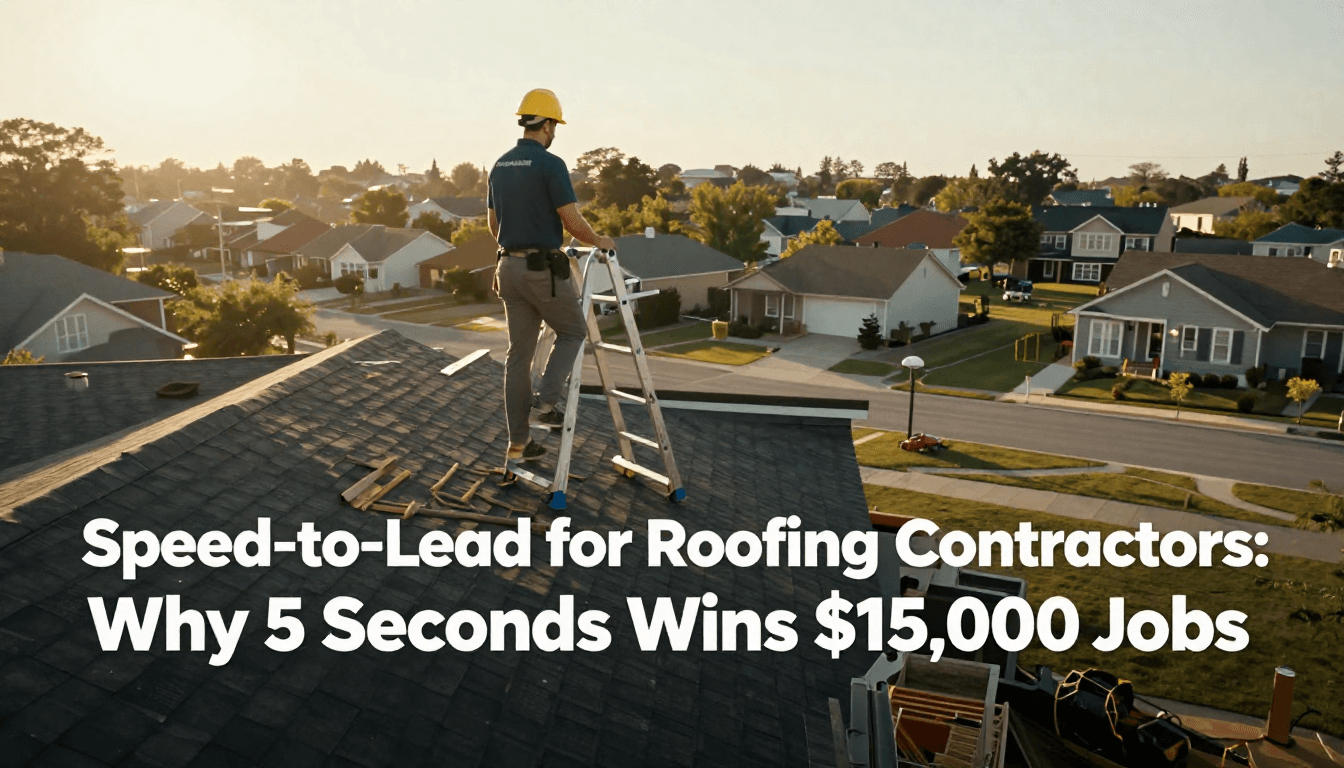
If you're running Meta ads for an HVAC, plumbing, or roofing business — or you're an agency that does — Andromeda has not been kind to your account. The verticals that built their playbook on tight detailed targeting, small geos, and 3–5 hero creatives per season are exactly the verticals Andromeda is least forgiving of. Most of the accounts we audit in these categories are paying 40–80% more per lead than they were 18 months ago, and the buyers running them are blaming the offer, the LP, the season, the economy — anything except the creative-volume floor that Meta's algorithm now silently enforces.
This is the unredacted version of what Andromeda did to home-services ad accounts, why the damage looks worse here than in other verticals, and exactly what to film this month at $3K/mo and $15K/mo production tiers to get out of it. Real numbers, real angle inventories, no hype.
If you're a contractor, brokerage, or agency serving HVAC/plumbing/roofing, this is the artifact you can hand to your media buyer or owner to defend the production budget the account actually needs in 2026.
TL;DR
- Home services accounts are disproportionately exposed to Andromeda because the legacy playbook (tight geo + interest stacks + 3–5 seasonal creatives) is exactly the input pattern Andromeda penalizes most.
- Advantage+ Audience is now the right default even for a single-zip-code roofer. The detailed-targeting muscle memory is the single biggest predictor of rising CPLs in this vertical.
- Volume floor for 2026: roughly 30 active creatives at $3K/mo spend, 60–80 at $7K–$10K/mo, 100+ at $15K/mo. Below those floors, Andromeda hedges your delivery and CPLs climb.
- Angle inventory matters more than production polish. A roofer needs 7 distinct angle families (storm, age, financing, before-after, technician-led, neighborhood, emergency). A polished one-angle campaign loses to a rough seven-angle batch.
- Geo-stacking under Andromeda: instead of one tight ad set per zip, run broader regional ad sets with creatives that mention the specific neighborhood as on-screen text. Andromeda's retrieval layer handles the geo match better than your manual targeting did.
- Production cadence: one 90-minute on-site shoot per month produces 40–80 distinct ad variants when run through a batch pipeline. That's the unit economics that makes the volume floor achievable.
Why Home Services Got Hit Harder Than Most Verticals
Andromeda evaluates roughly 10,000x more ad candidates per impression than Meta's previous ML stack, and it's optimized for accounts that give it broad creative variety to evaluate. Home services accounts historically did the opposite of that. Three structural reasons home services advertisers are unusually exposed:
1. Small geos, run as tight detailed targeting.
A roofing company serving 3 zip codes used to build the ad set as "those 3 zips + age 35–65 + homeowner + interested in home improvement." That worked beautifully in 2019 because Meta needed every signal you could give it. In 2026, that tight stack starves Andromeda's candidate pool — you've narrowed the impression universe so far that there's no room for the algorithm to find cheap inventory pockets. Tight detailed targeting actively raises your CPM now, even in small geos.
2. Narrow seasonal creative.
A roofer films a polished hail-damage spot in April, runs it through May–August, and calls it good. Andromeda's prediction model needs continuous new creative input to keep delivering. Three months of the same creative is a frequency disaster; the account fatigues by week 5 and the algorithm starts hedging CPM upward.
3. Seasonality interacting with auction pressure.
When the season turns (Q2 for roofing/HVAC cooling, Q4 for HVAC heating, post-freeze for plumbing), every competitor in your geo enters the auction at the same time. Andromeda's response to a sudden auction-density spike with thin creative inputs is to widen its CPM hedge — because it can't tell which advertiser will actually convert. Accounts with deep creative libraries cut through that hedge. Accounts with one hero spot get crushed by it.
The compound effect: home services accounts that ran the same playbook from 2019 are seeing 50–90% CPL increases in 2026 even when their offers and LPs haven't changed.
What Advantage+ Audience Actually Does For You
Most home-services buyers we audit still flinch at Advantage+ Audience. The fear is reasonable: "If I let Meta target broadly, I'll get clicks from people 200 miles outside my service area." That fear is dated. Here's what Advantage+ Audience actually does in 2026:
- You set the geo and minimum age constraints as hard floors. Meta won't deliver outside them.
- You provide a "suggested audience" hint (interests, behaviors, demographics) that Andromeda uses as a starting prior, not a hard filter.
- Andromeda then expands the audience dynamically per impression, using the creative as the matching signal. A roof storm-damage creative gets pitched to homeowners in storm-affected zips; a financing-led creative gets pitched to homeowners with longer-tenured homes and renovation history.
The shift: you're no longer telling Meta who to target. You're telling it where to deliver (geo) and giving it enough creative variety that it figures out who to target. That's the entire Andromeda mental model in one sentence, and it's the inverse of how home services accounts were built.
For a roofing/HVAC/plumbing account, the practical change:
| Old setup | New setup (Andromeda-aligned) |
|---|---|
| 3 zips + age 35–65 + homeowner + 6 interests | Service-area radius + age 28+ + homeowner + Advantage+ Audience |
| 1 ad set per geo | 1–2 ad sets per region (multi-geo) |
| 3–5 creatives per ad set | 30–80+ creatives per ad set |
| Manually exclude prior leads | Use CAPI to feed conversion events; let Andromeda re-exclude |
Buyers worry this means losing control. In practice, it means relocating control from the audience layer (which Andromeda overrides anyway) to the creative layer (where Andromeda actually pays attention).
The New Volume Floor By Spend Tier
The most-asked question we get from contractors and home-services agencies: "How many creatives do I actually need?" Below are the floors we've validated across dozens of HVAC, plumbing, and roofing accounts. These aren't theoretical — they're the points at which CPL curves bend.
$3,000/month spend tier
- Active creative floor: 25–35 ads in rotation
- New creative cadence: 8–10 new ads per week
- Hero shoots: 1 on-site shoot per month (90 minutes)
- Angle families covered: 5–6 (out of 7 — drop one or two seasonally)
- Realistic CPL range (US home services): $35–$75
$7,000–$10,000/month spend tier
- Active creative floor: 60–80 ads in rotation
- New creative cadence: 15–25 new ads per week
- Hero shoots: 1–2 on-site shoots per month
- Angle families covered: 7 (all)
- Realistic CPL range: $25–$55
$15,000+/month spend tier
- Active creative floor: 100–150 ads in rotation
- New creative cadence: 30–50 new ads per week
- Hero shoots: 2 on-site shoots per month + 1 customer-led shoot
- Angle families covered: 7+ with sub-variants per neighborhood
- Realistic CPL range: $18–$40
The brutal honesty: a $10K/month account running 8 creatives is leaving roughly half its budget on the table compared to the same account running 70 creatives. The CPL gap typically pays for the production cost 3–5x over, and that's before you account for the lead-volume increase compounding into more booked jobs.
The general framework for picking the right volume — across verticals — lives in how many ad angles do you need post-Andromeda. This post is the home-services-specific version of that math.
The Real Angle Inventory For HVAC / Plumbing / Roofing
The biggest production mistake home-services accounts make is running 30 variants of the same angle. Andromeda doesn't reward 30 hooks for "we're the best roofer in town." It rewards 7 fundamentally different reasons a homeowner would care, with 4–10 variants each.
Below is the angle inventory we use for HVAC, plumbing, and roofing campaigns. Read the headings as families, not as individual ads — each family produces 4–10 distinct creative variants.
Family 1: Problem-aware hooks
The viewer already knows they have a problem (leaking roof, broken AC, slow drain). The creative leads with the problem and resolves it with your service.
- "Three brown spots on the ceiling? Here's what they actually mean."
- "AC blowing warm? Five things to check before calling anyone."
- "Drain backing up at 11pm? Two questions to ask the first plumber who quotes you."
These work best for high-intent retargeting and broad prospecting against homeowners with active issues.
Family 2: Storm response / weather event
Vertical-specific but extremely high-performing during the relevant window. Storm response creatives outperform every other family by 2–4x during the 14 days after a regional event. We've covered this in depth in our roofing-specific operational playbooks, but the production rule is: have storm-response creative ready before the storm, not produced after.
- Drone footage of the affected neighborhood
- Technician explaining what insurance covers vs. doesn't
- Before-after of a recent claim handled
Family 3: Financing / payment-led
The friction in home services is rarely "do I need this." It's "how do I pay for it." Financing angles convert at premium rates when the math is on-screen and concrete.
- "$0 down, $89/month, 5-year warranty" with the math literally on the screen
- "How a $14K roof became a $147/month line item" — owner explaining the calculation
- "What FHA 203(k) actually covers" — short educational
Family 4: Before-after / transformation
This is the family every home-services account already films. The mistake is running 8 versions of the same before-after with different captions. Andromeda doesn't see those as distinct. Distinct means: different homes, different problems, different price points, different homeowner types.
- Older couple, 30-year roof, full replacement
- Young family, leaky pipe, cosmetic repair
- Investor / landlord, HVAC swap for tenant turnover
- Custom home, premium service tier
Family 5: Technician-led / behind-the-scenes
Your installer or technician on camera, explaining what's actually happening on a job. This is the family that performs disproportionately well on Reels and Shorts because it reads as native, not as an ad.
- "Day in the life of a roofer in [city]"
- "Three things your HVAC tech wishes you'd ask"
- "Why I always check the attic first" — installer POV
Family 6: Neighborhood-led / hyperlocal
This is the angle most accounts under-use. You don't need to target a specific neighborhood through ad set settings; you put the neighborhood name on the screen in the first 2 seconds of the ad, and Andromeda matches it to nearby users.
- "Just finished a job in [Neighborhood] — here's what they got"
- "Why so many homes in [Subdivision] need this repair" with footage from the area
- "5 of your neighbors on [Street] booked this last week"
Geo-stacking under Andromeda is about creative-side geo signals, not ad-set-side geo tightening. Counterintuitive but consistently the highest-performing approach we've measured.
Family 7: Emergency / urgency-aware
Different from problem-aware. Emergency creatives explicitly position the service as "we'll be there in [time]" — speed of response as the value prop.
- "47-minute response time average in [Region]"
- "We had a tech at her door in under an hour" — customer testimonial cut
- "Saturday at 9pm? Here's our line." — direct-to-camera urgency
Pair this with a fast lead-response system (most home-services accounts under-invest here too — see the missed-call text-back posts and related operational coverage if you haven't already).
Geo-Stacking Under Andromeda: The Counterintuitive Setup
The biggest setup-level change for HVAC/plumbing/roofing accounts in 2026 is how you handle multi-geo coverage. The old playbook (one ad set per zip, tight targeting) is the worst possible structure for Andromeda. Here's the structure that works in our audits:
Ad account architecture, multi-geo home services, 2026:
- One campaign per service line (e.g., Residential Roofing, Commercial Roofing, Emergency Service).
- One ad set per region, not per zip. Region = the rough drive-time area your crews actually cover. Most contractors have 1–3 regions.
- Advantage+ Audience on every ad set, with the region as the geo constraint.
- 30–80 creatives per ad set, with the neighborhood names appearing on-screen in the creatives, not in the targeting.
- CAPI feeding conversion events back to let Andromeda exclude prior leads automatically.
What this looks like in practice for a roofer covering 12 zips across 2 regions:
| Setup | Old playbook | Andromeda-aligned |
|---|---|---|
| Number of ad sets | 12 (one per zip) | 2 (one per region) |
| Targeting per ad set | Tight detailed | Advantage+ Audience |
| Creatives per ad set | 4–6 | 40–60 |
| Geo signal | Ad-set level | Creative-level (on-screen text) |
| CPM trend | Up 40–80% YoY | Down 15–30% YoY |
| CPL | $80–$120 | $35–$55 |
The wins come from two compounding effects: Andromeda has a bigger pool to retrieve from (because the ad sets aren't artificially narrowed), and the creative-level geo signal lets it match users more precisely than the old zip-level targeting could.
Production Cadence: What To Actually Film This Month
The volume floors are achievable for any account at any spend tier, but only if you change how you think about production. Here's the cadence that works.
The 90-minute monthly on-site shoot
One day per month, on a real job site, with one operator and one camera. Plan to capture:
- 20–30 minutes of technician-led explainer content — your installer talking through what's happening, B-roll of hands-on work
- 15–20 minutes of before-after walkthroughs — homeowner POV if available, otherwise installer narrating
- 10–15 minutes of customer testimonial — the homeowner on camera, casual, not scripted
- 15–20 minutes of B-roll — trucks, tools, the home exterior, the neighborhood
- 10 minutes of drone or wide-area footage if the job is roof/exterior
Total: 90 minutes of raw footage. Run through a batch production pipeline (we cover the economics in batch video ads), that produces 40–80 distinct ad variants across all 7 angle families.
Weekly micro-shoots
In addition to the monthly on-site, schedule 15–20 minutes of weekly micro-capture:
- Owner direct-to-camera on a quick topic (warranty, financing, common mistake)
- Phone-shot customer reaction (if customer consents)
- Tech in the truck explaining the next job
- Office-side B-roll (CSR taking a call, dispatcher mapping routes)
These low-friction captures cover the angle families the monthly shoot underweights (financing, technician-led, neighborhood-led) and keep the creative library refreshing weekly instead of monthly.
Production cost benchmarks (US, 2026)
| Tier | Monthly production budget | Creative variants/month | Approach |
|---|---|---|---|
| Lean | $400–$800 | 30–40 | Owner self-records + AI batch pipeline |
| Standard | $1,200–$2,500 | 50–80 | Operator-led monthly shoot + batch pipeline |
| Premium | $3,000–$5,000 | 80–150 | Operator + editor + batch pipeline + 1–2 hero spots |
Most home services accounts spend the right total on creative — they just allocate 100% of it to 4–6 polished spots and 0% to volume. The right allocation is roughly 80% volume / 20% polish, and the cost-per-variant economics only work with a batch pipeline.
The Cross-Channel Compounding Effect
The same shoot that produces 40–80 ad variants also produces organic content for your social presence. Most home-services accounts treat these as separate budgets and separate shoots, which is a 100% waste of the marginal effort. One 90-minute on-site capture, run through a unified pipeline, produces:
- 40–80 paid ad variants for Meta and TikTok
- 30–60 organic short-form posts (Reels, Shorts, TikTok)
- 10–20 long-form posts (educational walkthroughs, customer stories)
- 5–10 Google Business Profile updates with photos and short videos
- 3–5 written blog posts using the transcripts as raw material
This is what running done-for-you social media on top of batch video ads actually buys you — one production day, every output channel. Most contractors run two separate vendors (an ad agency and a social agency) and pay twice for the same footage. The Andromeda-era operational model collapses both into one.
What To Stop Doing This Month
If you're running an HVAC, plumbing, or roofing Meta account, three things to stop immediately:
- Stop using detailed targeting on ad sets. Detailed interest stacks ("homeowner + interested in home improvement + home renovation") are now a CPM tax, not a precision benefit. Move to Advantage+ Audience.
- Stop running fewer than 30 creatives at any spend level. Even at $2K/month, the volume floor matters — under it, your CPL is being capped by Andromeda's hedging.
- Stop refilming the same hero ad every quarter. Refilm the angle inventory (the 7 families above), not a single hero. Volume across families beats polish within one family every time.
Frequently Asked Questions
My CPLs are fine — do I really need this much creative?
Maybe not yet. The most common pattern we see is accounts whose CPLs were stable through 2024–2025 and started climbing sharply in Q4 2025 / Q1 2026 as Andromeda fully rolled into the auction. If you're still seeing stable CPLs at low creative volume, you're either in an under-competitive geo (rare) or you're about to see the curve bend. We recommend pre-emptively building the production cadence before CPLs force the issue, because the catch-up cost is significantly higher than the prevention cost.
Can I just use stock footage and AI-generated voiceover for all 60 creatives?
For roofing/HVAC/plumbing specifically: no. Home services has a credibility-signal requirement — viewers need to see real trucks, real techs, real homes, or the conversion rate collapses. AI voiceover is fine on top of real footage. Stock footage isn't. The minimum-viable production model is 1 real on-site shoot per month, then batch-process the footage with AI scripting and editing.
What about Google ads — does Andromeda affect those?
Andromeda is Meta-specific. Google has its own ML stack (Performance Max, Smart Bidding) with similar but distinct dynamics. The creative-volume principle generalizes — Performance Max also rewards more asset variety than it punishes — but the specific number of creatives, the geo-stacking approach, and the placement dynamics are different enough that you shouldn't treat them as the same problem. We'll cover Google separately.
How do I justify the production cost to my owner / GM?
The unit economics that work: pull your last 6 months of CPL data. Calculate what a 30% CPL reduction would have produced in additional booked jobs at your current close rate and ticket size. For most home-services accounts at $5K+/month spend, the math comes out to 5–15x the production cost in attributable revenue. The CFO conversation is easier when the production line item is framed as "the lever that takes CPL down 30%" instead of "more ads."
Does this apply to commercial home services (commercial HVAC, commercial roofing)?
Yes, with two adjustments: angle inventory shifts (less storm-response, more downtime-cost and capex-deduction angles) and the volume floor is slightly lower because the audience is smaller. A $10K/month commercial HVAC account can usually run at 40–60 creatives instead of 60–80, but the directional shift toward Advantage+ Audience and angle diversity is the same.
How does this interact with seasonal demand?
Build seasonal angle modules 30–45 days before the season — pre-cooling HVAC creatives in late Q1, pre-heating in late Q3, pre-storm-window in early Q2 for roofing. Andromeda's prediction model takes 5–10 days of consistent delivery to stabilize on a new creative, so the accounts that launch seasonal creative on Day 1 of the season are already 1–2 weeks behind. We get into the broader seasonal/CPM dynamic in why CPMs are rising and creative volume fixes it.
The Bottom Line
Andromeda didn't change what good advertising is. It changed what the auction rewards. For HVAC, plumbing, and roofing accounts specifically, that change is bigger than for any other vertical we work in — because the legacy playbook (tight geos, detailed interests, hero creatives, seasonal refresh) is the precise input pattern Andromeda treats most harshly.
The fix is mechanical, not philosophical: broader audience setup, deeper creative inventory across 7 angle families, one monthly on-site shoot run through a batch pipeline, and a willingness to let go of the "perfect ad" muscle memory. Accounts that make this shift in 2026 typically see CPLs fall 30–50% within 60 days, with the production cost paying for itself 3–5x over.
If you want this running on your account — the shoot, the batch pipeline, the organic compound — start with batch video ads for the paid creative engine, and layer in done-for-you social media if you want the same footage doing double duty across organic. Two vendors collapse into one, and the production line item finally earns its keep.
For the cross-industry framework this HVAC/plumbing/roofing analysis plugs into, see the Batch Video Ads Complete Guide (2026) — it covers the underlying volume math, production pipeline, and cost models that the Andromeda response is built on top of.
Related reading

A practical AI operating model for real estate investment funds: reconcile asset data, surface material discrepancies, route exceptions, and automate controlled work.
A 4-role home-services AI sales workflow for fast response, qualification, booking, and consent-based reactivation—with costs and human handoff.
A practical architecture for enterprise AI when systems disagree: conflict objects, source precedence, review queues, provenance, and decision receipts.