How We Ship 50+ Posts a Day With AI
How we use AI to produce and ship 50+ social posts per day — the workflow, the per-post economics, and how the math compares to a traditional social media agency retainer.

Most "done-for-you social media" pitches hide the same three line items: the editor hours billed back to you, the per-post cost as volume scales, and the reality that a $3k–$8k monthly retainer typically buys 20–40 finished posts — not the distribution footprint a coach, media buyer, CMO, or agency owner actually needs to compound reach in 2026.
This post is the unredacted version. The actual stack, the actual people, the actual screenshots behind a content engine shipping 50+ posts a day across 7 platforms — and the side-by-side pricing breakdown beyond the sticker so you can see what an agency retainer hides versus what high-volume posting actually costs per asset.
If you're a service business owner, agency owner, or CMO evaluating whether to build this in-house, keep paying a 30-posts-a-month agency, or run done-for-you social media with us, this is the artifact you can use to make that decision honestly — including the hidden costs vendors typically leave off the proposal.
One 90-minute pillar shoot per week becomes 350+ atomic posts. Six pipelines run in parallel. A two-person editorial pod supervises the swarm. Live in 24 hours from account access.
TL;DR
- One pillar shoot = 50–150 atomic posts. Long-form capture (podcast, walk-and-talk, interview) is the only human-heavy step. Everything downstream is AI-assisted and human-supervised.
- Six parallel pipelines: Source → Atomization → Variation → Distribution → Performance → Compliance. Each owns a specific failure mode.
- 7-platform fan-out: Instagram (Reels + grid), TikTok, YouTube Shorts, Facebook Reels, X, Threads, LinkedIn — plus Google Business Profile where it matters.
- Multi-account stack: brand + founder + 2–4 niche/topic accounts, with cross-posting that re-formats the same atomic asset for 3+ surfaces.
- Daily review loop, not weekly. Top-decile posts get doubled-down within 24 hours. Bottom-decile dies on contact.
- Two humans in the loop per account stack — an editor and a strategist. Not 12 designers. The whole point of the AI content department model is to drive marginal post cost toward zero.
The Receipts (Before the Theory)
Before any framework: three screenshots of what 50 posts/day across the swarm actually looks like in-platform. These are real account dashboards from inside the operation.
Multi-account posting cadence — one of several brand stacks in the swarm.
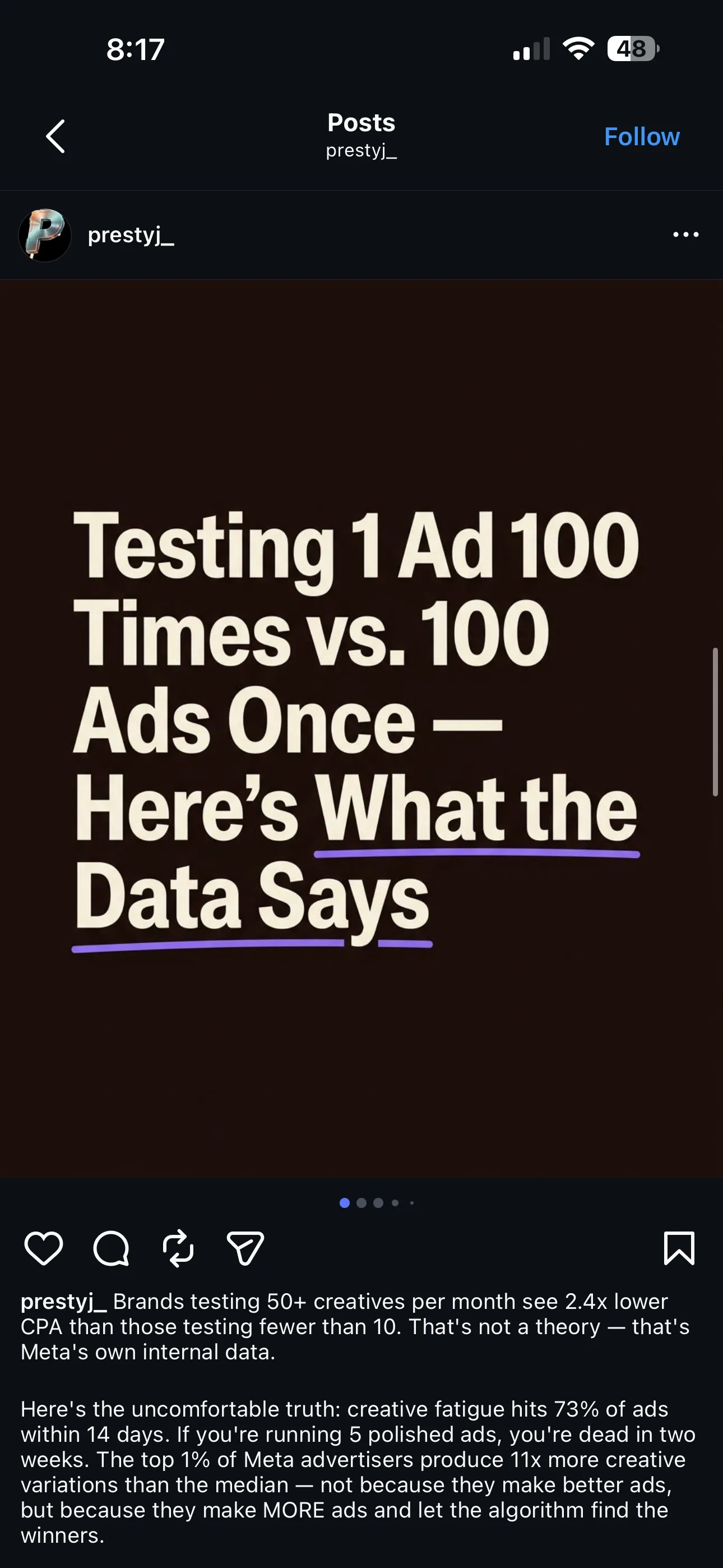
Above-threshold reach after the recommender starts trusting the account.
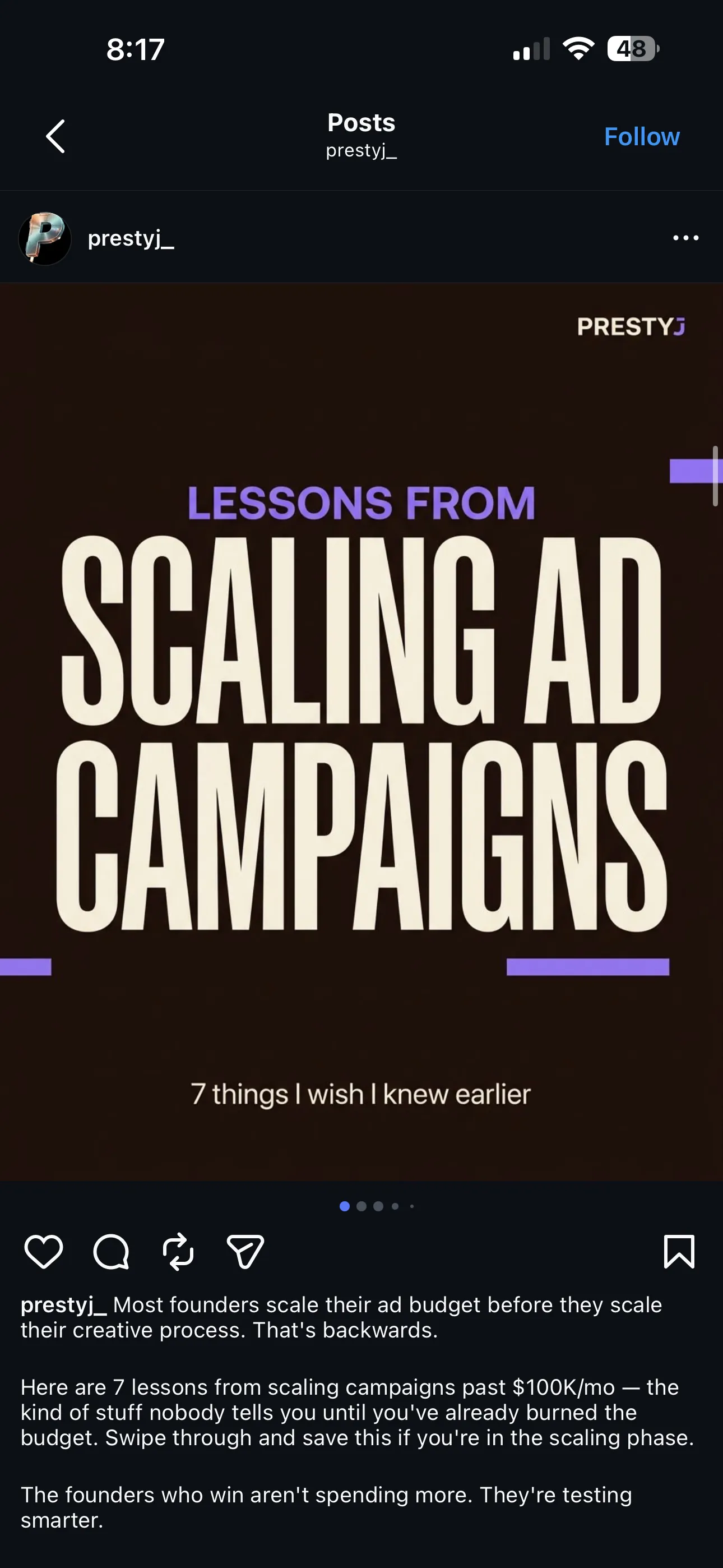
Daily breakout posts surfaced by the performance pipeline for double-down.
These are not the best week. They're a representative week. The point isn't to flex — it's to anchor the rest of this post in something concrete before we get into the workflow.
The Stack at a Glance
Six pipelines, each owning one failure mode. If any pipeline breaks, the swarm slows down in a specific, diagnosable way — not a vague "things feel off."
Podcast, walk-and-talk, on-site shoot, sales call recording, customer interview. The only meaningfully human step.
AI-assisted clipping, auto-captioning, hook extraction, B-roll injection, format conversion (vertical / horizontal / square / static).
Each cut ships in multiple jacket styles. The recommender picks the winner. We don't pre-decide.
Native uploaders where the algorithm punishes third-party APIs. Direct API where it doesn't. Different formatting per surface.
Top-decile posts get re-cut into 3–5 derivative posts and fed back into atomization the same day.
Guardrails enforced at the variation step, not at the distribution step. Catching off-brand at distribution is too late.
Pipeline 1 — Source Capture: The Only Meaningfully Human Step
Everything downstream depends on one thing: enough raw signal at the top of the funnel. A pillar piece is anything that produces 30–120 minutes of on-brand, on-topic, on-camera (or on-mic) source material we can cut from.
What we use as pillars, in priority order:
- A weekly podcast or long-form video. The format that produces the most cuts per minute of capture.
- Walk-and-talk shoots. 30–45 minutes, one camera, one operator. Single best ROI per dollar.
- Recorded sales calls or customer interviews (with consent). Highest signal density for B2B and service businesses.
- On-site / in-the-field shoots. Job sites, behind-the-scenes, before/afters, transformations. Visual gold.
- Existing libraries. Old YouTube uploads, webinar recordings, conference talks, internal Loom videos.
One pillar per week, minimum, per account stack. Skip a week and the swarm runs dry in 14 days. Skip two weeks and the algorithm starts demoting the account because the cadence falls below threshold.
For clients on done-for-you social media, we run the capture for them — show up to the location or the Zoom, run the camera, ask the questions, leave with the raw files. For clients on the AI content department tier, they self-capture against a weekly prompt list we send.
Either way: this is the bottleneck. Everything else scales. Capture doesn't.
Pipeline 2 — Atomization: Where 1 Pillar Becomes 50–150 Posts
This is the step that makes the math possible. A 60-minute podcast contains, conservatively:
- 8–20 vertical short-form clips (15–60s each, hook-first cuts)
- 4–8 horizontal long-form clips (2–8 min each, for YouTube and LinkedIn)
- 5–10 carousel posts (key arguments, frameworks, lists)
- 10–20 quote cards (single-line excerpts on branded backgrounds)
- 20–40 threaded text posts (X / Threads / LinkedIn one-liners, hot takes, observations)
- 5–10 audio clips (for podcast surfaces and X audio cards)
That's 52–108 atomic posts from a single capture session. Stack two pillar pieces in a week and you're at 100–200 atomic posts ready to schedule — comfortably above the 50/day threshold across the swarm.
Transcribes the pillar with speaker diarization
Identifies hook moments by semantic + retention modeling
Cuts to vertical/horizontal/square with reframing
Burns word-by-word captions in brand-safe styles
Generates 5–10 caption
- hook variants per cut
Suggests thumbnails, B-roll inserts, and music beds
Approve a cut without an editor's eyes on it
Make claims, numbers, or guarantees that weren't in the source
Pick the brand's strategic priorities for the week
Override compliance flags from Pipeline 6
Decide which winners to double-down on (that's the strategist)
Talk to the client. Humans only.
The editor's job at this stage is rejection, not creation. They watch a queue of AI-generated cuts at 2x speed and kill anything off-brand, off-voice, or boring. The keep rate hovers around 70–85%. Anything below 60% means the source pillar was thin and we need to flag it back to the strategist.
Pipeline 3 — Variation: Why Every Asset Ships in Five Jackets
Here's the rule that took us six months to internalize: the cut is not the post. The cut is the seed. The post is the cut + a hook + a caption + a thumbnail + a posting time + a platform-specific opener.
We never ship one version of a cut. We ship 5–10. Same 30-second clip, different first-frame thumbnail, different on-screen hook text, different caption opener, different hashtag set. The recommender picks the winner. We don't pre-decide.
This is the part that's invisible in agency pitches and obvious to anyone who's actually run volume. A cut that flopped at 800 views in jacket A regularly hits 80,000 views in jacket C. The hook variation is doing 90% of the algorithmic work. Believing you can pick the winning hook in advance is the single most expensive belief in social media.
Every atomic cut gets 5–10 variants generated automatically. We schedule 2–3 of them in week 1, hold the rest in reserve, and ship the reserves in weeks 2–6 if the cut showed any signal. A cut that flops in all variants gets killed and replaced.
Pipeline 4 — Distribution: 7 Platforms, 3–5 Accounts, Native Where It Matters
Distribution is unglamorous and underrated. Most agencies use one third-party scheduler, push the same asset to every platform, and call it a day. The algorithms see this. They demote it.
Our distribution rules:
9:16, captions burned in, hook in first 1.5s, CTA at 80% of runtime, 3–5 hashtags max, posted via native uploader.
9:16 with platform-native fonts on overlays, hook in first 1.0s, hashtags in caption (not first comment), trending sounds when contextually honest.
9:16, longer-tolerance hooks (2.0s), title-bait first frame, descriptions optimized for search not feed.
Square or 4:5 video, 7/10 professional voice on captions, hook in first line of text, no link in post body (link in first comment).
Punchy text-first posts, video as supporting evidence, threading where the argument runs long, posted 5–15x/day.
9:16 with larger captions (older homeowner demo), longer hook tolerance (2.5s), post via Meta's native Reels composer.
1 post/day with local-relevance keywords, photo + 1500-char update, direct lead intent capture.
The multi-account stack is the other half of distribution. A single account, even at threshold, caps at one audience. Three to five accounts (brand + founder + niche topics) caps at three to five audiences — and lets us run hooks the brand account couldn't safely run.
Pipeline 5 — Performance: The Daily Review Loop
This is the pipeline that separates a content engine from a content treadmill.
Every morning, the strategist on each account stack opens the performance dashboard and tags posts from the previous 24 hours into one of three buckets:
Re-cut into 3–5 derivative posts the same day. Push reserve variants. Cross-post to other accounts in the stack. Boost via paid where the unit economics work.
Let it run. Some sleeper hits emerge in days 3–10 as the recommender slow-tests them. We don't kill anything in this bucket prematurely.
Pull from rotation, archive the variant, and feed the failure pattern back into Pipeline 3 so the variation layer stops generating that mistake.
The double-down loop is where the compounding lives. A breakout post that hit 200K views on TikTok on Monday becomes:
- 3 alternate-hook re-cuts shipped Tuesday
- 1 horizontal version shipped to YouTube Shorts Wednesday
- 1 carousel version shipped to Instagram and LinkedIn Thursday
- 1 thread version shipped to X and Threads Friday
- 1 quote card shipped to Facebook and Instagram grid Saturday
One winner becomes seven follow-ups in seven days. That's how baseline reach climbs week-over-week even when raw output stays flat.
Pipeline 6 — Compliance: The Quiet One
Most volume operations break here. They ship 1,500 posts a month for nine months, then one post says something legally indefensible or off-brand enough that the founder pulls the plug on the whole engine.
Compliance has to be enforced at the variation step, not the distribution step. Once a caption is generated and queued, catching it 30 seconds before it ships is too late — the editor is reviewing 200 posts that day.
What the compliance pipeline checks before a variant is allowed into the queue:
- Brand voice fingerprint — does the caption match the trained voice profile within tolerance?
- Claim guardrails — no specific revenue claims, no medical claims, no income guarantees, no superlatives the legal team hasn't approved
- Asset rights — every clip, photo, and music bed has a tracked rights record
- Industry regs — fair housing language for real estate, HIPAA for healthcare, FTC disclosure for affiliate content
- Founder veto list — phrases, opinions, and topics the founder has explicitly opted out of
Compliance flags route to a human queue, never auto-approve, never auto-publish. This is the one pipeline where we slow down on purpose.
A Day in the Life of the Swarm
To make this concrete, here's a real schedule from a representative account stack on a representative Tuesday.
Strategist review. 25 minutes. Tags Monday's posts. Identifies 4 winners for double-down.
Editor sweep. Queue review on overnight AI cuts from Monday's pillar. 75 cuts in, ~58 cuts out (77% keep rate).
Variation generation. 58 cuts × 6 variants = 348 candidate posts. Compliance pipeline flags 11. Editor resolves.
Scheduled distribution. 52 posts ship across TikTok (12), Reels (10), Shorts (8), Facebook (6), X (10), Threads (4), LinkedIn (2).
Mid-day double-down. Tuesday's morning post on TikTok is hitting 40K views in 5 hours. 3 derivative re-cuts queued for Wednesday.
Overnight AI batch. Atomization runs on the next pillar. 90 candidate cuts ready for Wednesday's 7am editor sweep.
Total human time on the account stack that day: roughly 2.5 hours of editor work + 45 minutes of strategist work + 15 minutes of compliance review. Three and a half hours of human labor produced 52 posts.
That's the unit economics that make the math work. A 30-posts-a-month agency burns 3–4 hours of human labor per post. We burn 4 minutes.
What This Stack Costs to Run
We get this question every week, so here's the honest answer.
The thing that makes done-for-you social media at this volume economically possible is that the marginal cost per post is dominated by infrastructure (transcription, GPU inference, scheduler licenses, storage) not by labor. Labor scales with account stacks, not with post count.
A single editor + strategist pod can supervise 4–6 account stacks shipping 50+ posts/day each. That's 200–300 posts/day per pod at a labor cost that would have produced 6–10 posts/day at a traditional agency.
This is the only model that produces 1,500–2,700+ posts per month per client without the per-post cost making it economically suicidal.
What We Refuse to Do (And Why)
A few things that come up in sales calls regularly that we won't take on, no matter the contract size.
How Onboarding Works (24 Hours from Account Access)
Most agencies take 4–8 weeks to "ramp." We ship in 24 hours from the moment you give us account access. Here's how:
You hand over platform access. We pull existing content, train the brand voice profile, lock the compliance ruleset.
Founder records (or we shoot) one 60-minute pillar against our prompt list. Atomization starts the moment files arrive.
Editor runs first sweep. Variation pipeline generates the first 7 days of posts. Distribution queue fills.
Engine goes live. Daily review loop starts on day 2. First measurable reach climb typically lands in week 2–3.
When This Model Is Wrong For You
We won't pretend this is universally the right answer. The high-volume engine is the right move when:
- You're a service business, B2B brand, or category-leading operator who needs distribution to compound month-over-month
- You can produce or sit for one weekly pillar, every week, without flaking
- You're spending $2K–$10K/month on social already and not seeing distribution outcomes
- Your category is under-saturated on short-form (i.e. most categories outside lifestyle and entertainment)
It's the wrong move when:
- You only need 4–8 hyper-polished posts per quarter for an enterprise brand calendar
- You can't or won't produce weekly source material
- You expect per-post approval workflows
- Your category is so regulated that every claim requires legal sign-off (we can do this, but the unit economics shift hard)
If any of those describe you, a traditional 30-posts-a-month agency might honestly be the right call. If they don't — if you actually want distribution — there's no reasonable path to 1,500+ posts/month that doesn't look approximately like the stack above.
The Bottom Line
The Prestyj content engine isn't magic, and it isn't free. It's six pipelines, two humans per account stack, one weekly pillar, and a daily review loop — all stacked so the marginal cost of the 51st post each day is functionally zero.
That's what an AI marketing agent looks like in production. The AI Content Department is this exact stack — source pipeline, atomization, variation, distribution, performance, and compliance — run on your accounts, in your brand voice, live in 24 hours. Everything else is grooming the brochure.
Frequently Asked Questions
How is this different from just hiring a social media VA?
A VA can produce 3–8 posts per day at the upper bound of sustainable output, with no atomization pipeline, no variation engine, no daily double-down loop, and no compliance layer. The Prestyj engine produces 50+ posts per day per account stack with all six pipelines running in parallel. Different unit of value, different unit economics.
Do we have to be on camera?
It compounds 30–50% faster if the founder shows up on camera weekly, but it's not strictly required. Brand-only stacks work — they just take longer to cross the algorithmic threshold. We'll always recommend a founder account in parallel where the founder is willing.
How long until we see results?
Month 1 is the algorithmic cold start — most posts underperform while the recommender learns the account. Month 2 produces first breakout posts. Month 3 is when compounding kicks in and reach scales non-linearly. Month 6 is when the distribution moat becomes visible to competitors.
What platforms do you cover?
Instagram (Reels + grid), TikTok, YouTube Shorts, Facebook Reels, LinkedIn, X, Threads — plus Google Business Profile where local lead intent matters. We add or remove platforms per client based on where the audience actually lives.
Who owns the content?
You own your brand voice profile, your asset library, every post generated, and all the analytics. The orchestration code and variation models are ours. Standard SaaS-style boundaries.
What's the difference between done-for-you and the AI content department?
Done-for-you social media runs the full swarm — multi-account stack, 1,500–2,700+ posts/month, weekly pillar capture handled by us. The AI content department tier is the replace-a-hire footprint — 1,000+ posts/month, lighter onboarding, you handle pillar capture against our prompts. Both ship in 24 hours from account access.
Related reading
Why the standard 30-posts-a-month social media plan doesn't move the needle for service businesses — the algorithmic threshold for compounding reach, the real per-post cost of agency retainers, and what posting volume actually drives growth in 2026.

A practical AI operating model for real estate investment funds: reconcile asset data, surface material discrepancies, route exceptions, and automate controlled work.
A 4-role home-services AI sales workflow for fast response, qualification, booking, and consent-based reactivation—with costs and human handoff.